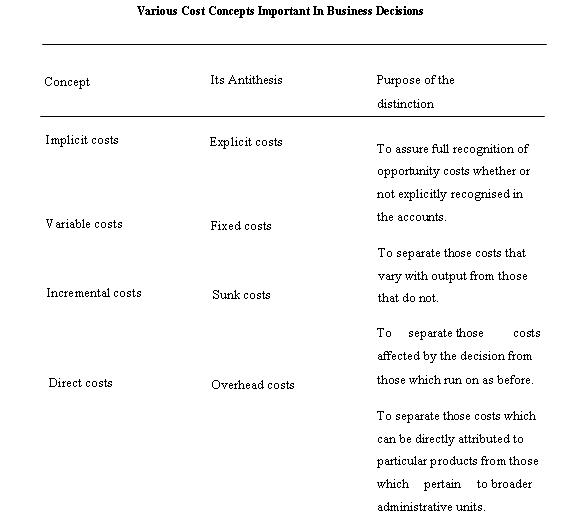
Marginal and Incremental Costs
1. Definition
1.1 Incremental cost is closely related to the economist's marginal
cost. Marginal cost may be defined as the addition to the total cost resulting
from producing one more unit. Incremental cost may be defined as the addition
to total cost resulting from a particular decision. Both are concerned
with changes in total cost, say increase or decrease in total costs that
result from producing and distributing additional or fewer units of a
product, or from a change in the method of production or distribution
such as the use of improved machinery, addition of a product or territory,
or selection of an additional sales channel. They are anticipated costs
and refer to future operations. The term incremental cost is more widely
used in business for reasons that are clear. First of all, businesses
are concerned with more than increasing or decreasing the level of output.
For example, in purchasing a new labour- saving machine, what is wanted
is a measurement of the prospective savings in cost (reduction in total
cost) resulting from that machine. Secondly, even if the issue is one
of in- creasing or decreasing output, businessmen normally think in terms
of increases or decreases of a substantial percentage rather then by a
single unit. The incremental cost concept is a more flexible tool, though
in some respects a cruder one than marginal costs.
1.2 Marginal or incremental cost represents the net effect of the choice
of alternatives. If we are referring to output, the incremental cost of
added production is the difference between the cost of producing the larger
output and the cost of producing the previous smaller output. Similarly,
if we are referring to sales, the incremental cost of selling an additional
item is the difference between the cost of selling with the item included
and the cost of selling without it. Incremental cost refers to the costs
of alternative courses of actions in the context of the installed capacity
and resources already available. Many a time, managements are confronted
with the problems of producing or selling an extra item, appointing an
additional salesman, or covering an additional sales territory, etc.
In such situations, in order to arrive at correct decisions, they will
have to take into account the existing resources and also the fixed costs
and calculate the additional cost on account of producing or selling an
extra item or covering an extra sales territory. If we apply the traditional
cost accounting method, it will lead to a misleading picture as it will
take into account all the existing and the fixed costs and arrive at a
unit cost of production, which in all probability will be more than the
incremental cost. The marginal cost concept rectifies this defect and
gives only the additional cost on account of producing or selling an additional
item. We shall illustrate \ this point by taking a simple example.
2. Application
2.1 The types of business problems to which the incremental cost concept
is applicable are without number. A few illustrations will suffice to
indicate the wide applicability of the concept.
- A firm with idle facilities might investigate the possibility that
a special order at below the usual price could cover the incremental
costs and make a contribution to overhead and profit. In evaluating
such a proposal, the management should make certain that the additional
revenue from such a sale is itself entirely incremental, and does
not damage the regular sales of the company. Again, such business
should not be taken if there are more profitable ways of using the
facilities.
Example:
|
With existing production |
Additional Production (1,OO0units) (10,000
units) |
Fixed cost |
Rs. 30,000 |
|
Variable cost |
Rs. 60,000 |
Rs. 6,000 |
Total cost |
Rs.90,000 |
Rs. 6,000 |
Cost per unit |
Rs.9 |
Rs.6 |
The additional production is not charged fixed costs as the same
is expected to be absorbed by the initial or existing production.
Increment cost of additional production of 1,000 units is the variable
cost of Rs. 6,000
only, i.e. Rs. 6 per unit. The factory cannot, therefore, sell at
a price lower than Rs. 6 per unit. In other words, it is worthwhile
for the unit to go in for additional production only if the latter
can fetch a price above Rs. 6 per unit.
- A firm considering a reduction in price should compare the incremental
cost of the additional output it will sell with the additional revenue,
taking into account that some revenue will be lost through the reduction
in price itself.
- A passenger airline with the idle space on many of its planes might
consider whether some cargo shipped in that idle space would bring
in added revenue which would more than cover the incremental costs
involved. In such a case, the incremental costs should be low, because
the planes will fly anyway and there will be few added costs in including
the cargo.
- A company facing the decision to make or buy, that is, to manufacture
a part itself or buy from outside should compare the incremental cost
of manufacture (rather than the full cost) with the outside price.
Other considerations would enter into such a decision of course, such
as supplier dependability, and company know how, but the relevant
cost concept is the incremental one.
- An Example:
A unit manufacturing table fans is buying the fan guards from outside
at Rs. 30 per set. Is it economical to make this item in the unit
itself, and if so what will be the cost?
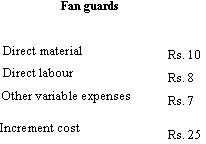
Fixed overhead is Rs. 1,000, but this is not charged to the fan
guards as these expenses are expected to have been already recovered.
The incremental cost of making fan guards is therefore Rs. 25 per
piece which is Rs. 5 lower than the market price. It would be advisable
for the unit, therefore, to take up the manufacture of this item also.
- Similarly, when you have to make decisions regarding the extra
use of transport, crane or material handling equipment, space or scrap
utilisa- tion, byproduct development, optimum utilisation of plant
capacity (by selling below the conventional cost price in slack season)-
decisions on all these can be taken only on the basis of incremental
costs.
- A utility attempting to sell off-peak services (it being a serious
problem in most utilities that consumption of such services is not
steady, leaving considerable idle capacity) should investigate whether
special rates or other attractions to off-peak use will bring in revenues
which will more than cover incremental costs .
- Process Installation: One other decision which managements are
called upon to make oftentimes is whether to install a new process
required for making a product, or get the product processed outside.
Here again the decision whether to have the process or not will have
to be based on the increment cost principle. Let us illustrate this
by an example: A light engineering workshop manufactures all its components,
and processes them within the plant except for heat-treatment which
is got done outside. A little thinking on the part of the management
reveals that space is available in the factory for setting up this
process also, the foreman and a few workers know the heat-treatment
techniques well, and could do this work without causing dislocation
of their regular jobs. The installation of the process, however, would
necessitate some additional equipment. Management has to decide whether
to install the heat-treatment process within the plant, or continue
to have it done outside.
- In this case, the incremental costs are the costs of equipment,
power, raw materials and chemicals associated with the heat-treatment.
This has to be compared against the cost of the heat-treatment outside,
transportation cost, handling cost, cost of placing an order, and
the cost of lost time in case deliveries are irregular. It may well
be that the incremental cost of the process may be less than getting
the work done outside. If the management had worked out the average
unit cost of heat- treatment within the factory, it would have shown
a higher cost which would have led to an incorrect management decision.
- How to charge new or additional production: Very often plants are
set up, equipments and machineries are purchased, production capacities
are built up, the costs of which are recovered over a period of years.
The burden of the fixed cost ceases to exist at the end of this period
and an enterprise is left with a number of assets in good working
condition. If a new production programme has to be undertaken at the
end of this period, how much will it cost the management? And given
a sales price, how much profit will the firm make? Since the burden
of the fixed cost has already been take care of in the initial plant
output over a period ofYears, the cost of undertaking new production
would be basically variable cost plus any other element of costs for
developing such production programmer.
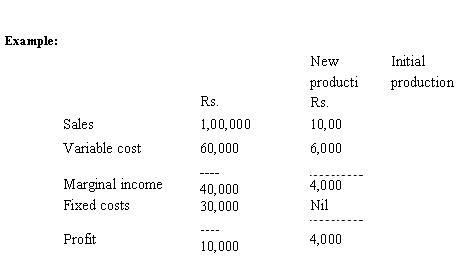
This statement shows that the new production is charged with the
variable cost only, with the initial production absorbing all fixed
costs. The increment cost of new production is, therefore, Rs. 6,000.
The new production could be sold at any price above Rs. 6,000. This
example shows that so long the incremental income exceeds the incremental
costs, it would be worthwhile to go in for such production, even though
on the average cost analysis this may appear to be a loss.
- Can we sell below the cost price and still make a profit?This proposition
appears to be somewhat unwise, but the increment cost analysis will
show that it is not. Many industrial units at times find themselves
having excess capacity of both men and machines, and would be glad
to accept orders at 'lower prices' or be prepared to sell products
at a price lower than the conventional unit cost price in order to
keep the plant running to full capacity. (There are in fact decisions
in favor of optimum plant utilisation). Such situations may arise,
for instance, when units are working below plant capacity due to shortage
of raw materials or during slack seasons. Let us illustrate our point
by an example:
A corner space of a factory is not in current use. It is contemplated
make use of the corner space, and produce a new item. The average
rent of the unused corner space is Rs. 6,000 per year during which
period 10,000 units of the new item can be made. Other fixed costs
(already existing) for the quantity works out to be Rs. 6,000plus
Rs. 3,000 for extra equipment, supervision, etc. The variable cost
by way of extra labour, material, power, etc., works• out to Rs. 2.50
per unit. Thus the total cost of 10,000 units would be Rs. 40,000,
i.e. Rs. 4 per unit. The incremental cost in this case would amount
to only Rs. 3,000 as cost of extra equipment plus Rs. 25,000 as variable
cost making a total of Rs. 28,000 for manufacturing 10,000 units,
i.e. Rs. 2.80 per unit. Thus, even though the average cost as per
conventional pattern is Rs. 4 per unit, the firm would still make
a profit if the goods are sold at Rs. 3 per unit (i.e. below the conventional
cost prince which is Rs. 4 per unit) so long as the price exceeds
the incremental cost of Rs. 2.80 per unit.