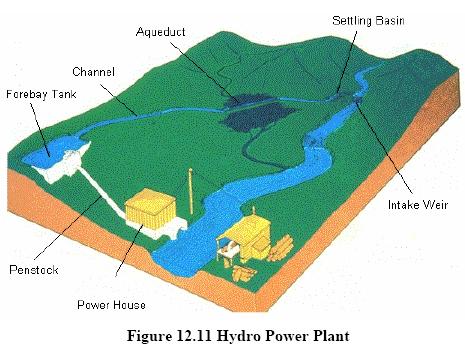
The potential energy of falling water, captured and converted to mechanical energy by waterwheels, powered the start of the industrial revolution. Wherever sufficient head, or change in elevation, could be found, rivers and streams were dammed and mills were built. Water under pressure flows through a turbine causing it to spin.
The Turbine is connected to a generator, which produces electricity (see Figure 12.11). In order to produce enough electricity, a hydroelectric system requires a location with the following features:
Change in elevation or head: 20 feet @ 100 gal/min = 200 Watts. 100 feet head @ 20 gal/min gives the same output.
In India the potential of small hydro power is estimated about 10,000 MW. A total of 183.45 MW small Hydro project have been installed in India by the end of March 1999. Small Hydro Power projects of 3 MW capacity have been also installed individually and 148 MW project is under construction.
Small Hydro Power is a reliable, mature and proven technology. It is non-polluting, and does not involve setting up of large dams or problems of deforestation, submergence and rehabilitation. India has an estimated potential of 10,000 MW
Hilly regions of India, particularly the Himalayan belts, are endowed with rich hydel resources with tremendous potential. The MNES has launched a promotional scheme for portable micro hydel sets for these areas. These sets are small, compact and light weight. They have almost zero maintenance cost and can provide electricity/power to small cluster of villages. They are ideal substitutes for diesel sets run in those areas at high generation cost.
Micro (upto 100kW) mini hydro (101-1000 kW) schemes can provide power for farms, hotels, schools and rural communities, and help create local industry.
Tidal electricity generation involves the construction of a barrage across an estuary to block the incoming and outgoing tide. The head of water is then used to drive turbines to generate electricity from the elevated water in the basin as in hydroelectric dams.
Barrages can be designed to generate electricity on the ebb side, or flood side, or both. Tidal range may vary over a wide range (4.5-12.4 m) from site to site. A tidal range of at least 7 m is required for economical operation and for sufficient head of water for the turbines.
Oceans cover more than 70% of Earth’s surface, making them the world’s largest solar collectors. Ocean energy draws on the energy of ocean waves, tides, or on the thermal energy (heat) stored in the ocean. The sun warms the surface water a lot more than the deep ocean water, and this temperature difference stores thermal energy.
The ocean contains two types of energy: thermal energy from the sun’s heat, and mechanical energy from the tides and waves.
Ocean thermal energy is used for many applications, including electricity generation. There are three types of electricity conversion systems: closed-cycle, open cycle, and hybrid. Closed cycle systems use the ocean’s warm surface water to vaporize a working fluid, which has a low boiling point, such as ammonia. The vapour expands and turns a turbine. The turbine then activates a generator to produce electricity. Open-cycle systems actually boil the seawater by operating at low pressures. This produces steam that passes through a turbine / generator. The hybrid systems combine both closed-cycle and open-cycle systems.
Ocean mechanical energy is quite different from ocean thermal energy. Even though the sun affects all ocean activity, tides are driven primarily by the gravitational pull of the moon, and waves are driven primarily by the winds. A barrage (dam) is typically used to convert tidal energy into electricity by forcing the water through turbines, activating a generator.
India has the World's largest programmes for renewable energy. Several renewable energy technologies have been developed and deployed in villages and cities of India. A Ministry of Non-Conventional Energy Sources (MNES) created in 1992 for all matters relating to Non-Conventional / Renewable Energy. Government of India also created Renewable Energy Development Agency Limited (IREDA) to assist and provide financial assistance in the form of subsidy and low interest loan for renewable energy projects.
IREDA covers a wide spectrum of financing activities including those that are connected to energy conservation and energy efficiency. At present, IREDA's lending is mainly in the following areas: -